EF-Map data is more useful when it can leave EF-Map. A scout should be able to drop a route into Discord. A tribe member should be able to post player or tribe context without asking everyone else to open the full map first. A weekly report should be readable in a channel, a DM, or a Reddit thread before someone decides to click through.
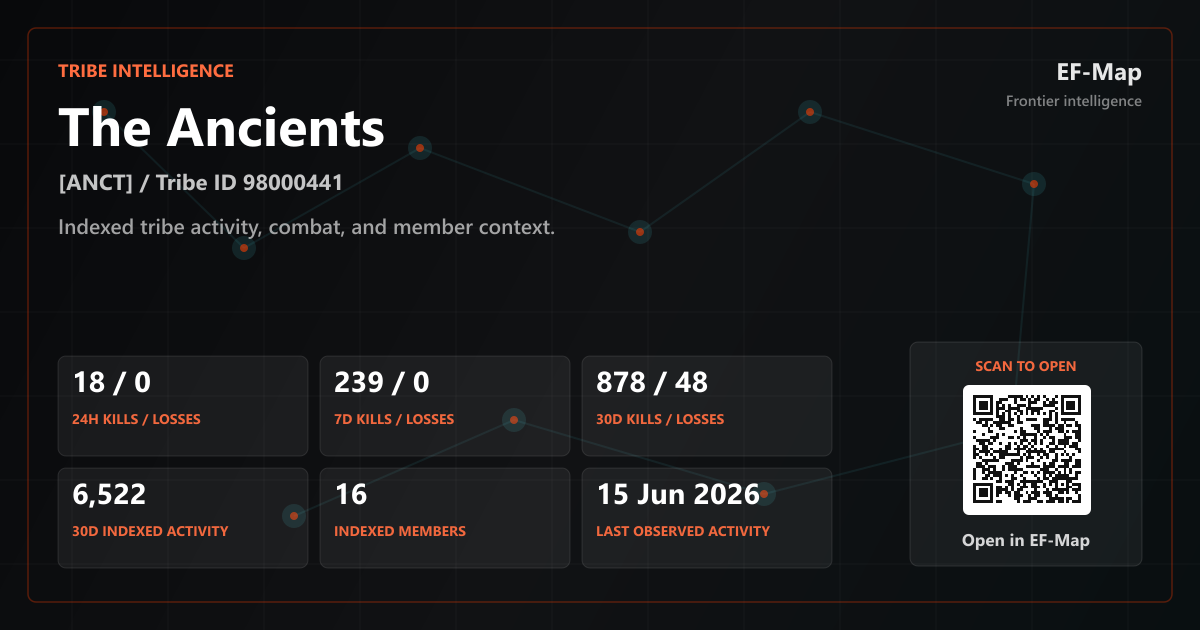
That is the reason behind shareable intelligence cards. They turn useful EF-Map context into a fixed 1200x630 PNG with a branded layout, key metrics, and a QR path back to the live map.
What the cards are
The first version supports the surfaces where EF-Map already has useful share context:
- System Intelligence cards
- Player Intelligence cards
- Tribe Intelligence cards
- Point-to-point route cards
- Scout Optimizer route cards
- State of the Frontier report cards
The card above is a tribe intelligence card for The Ancients. It is not meant to be a complete intelligence product by itself. It is a portable snapshot that gives someone enough context to understand why the link is worth opening.
Why the first version is PvP and activity heavy
The current cards mostly focus on PvP, indexed activity, members, routes, and weekly report metrics because those are the data sets EF-Map can surface confidently right now. EVE Frontier is still an alpha game, and data availability changes as the game, indexers, and public tooling mature.
That is a normal constraint. A card framework does not need final data coverage to be useful. It needs a reliable first shape: a title, context, metric tiles, a link target, and a way to get the viewer back into the live product.
Once that framework exists, future changes can replace or add boxes. If EF-Map gains better resource context, industry context, exploration context, or richer solar-system signals, those can become new card templates without starting from a blank page.
The QR code lesson
The most useful part of this feature came from manual smoke testing. Early generated PNGs printed a raw URL directly into the image. That was technically information, but it was poor UX. Text inside an image is not clickable. Someone would have to read it, type it, or hope their client detected it.
Manual review caught that before the feature settled. The card changed from "here is a screenshot with a link printed on it" into "scan this and open the EF-Map context." Route cards also use short share links where possible, so the route payload can travel through a compact `/s/` URL instead of a long encoded hash.
This is the same lesson described in the AI workflow blog post: agents can build a feature that passes code checks, but a human still has to ask whether it works in the place players actually use it. Discord images need a real way back to the map.
How the cards are generated
The app-side cards are generated client-side from the same Intelligence and route data already visible in EF-Map. The share-card model collects the title, subtitle, summary, up to six metric tiles, a filename, and an open URL. The renderer then draws a 1200x630 canvas image with the EF-Map dark background, orange accent, grid and map lines, metric blocks, title area, and QR/open panel.
QR codes are generated in the browser from the open URL. Intelligence cards deep-link back to the relevant system, player, or tribe Intelligence context. Route cards build from the current route summary and try to create a short share link before falling back to the normal route hash. State of the Frontier report pages use a static-page version of the same idea for report summaries.
The important detail is that the PNG is a snapshot. If a tribe's indexed activity changes later, an old card does not update. The QR/open target is the bridge from that static snapshot back to the current EF-Map view.
| Surface | Current card role | Open target |
|---|---|---|
| System, player, tribe Intelligence | Portable indexed context for Discord, DMs, Reddit, and planning threads. | The matching EF-Map Intelligence panel. |
| P2P routes | Travel summary with jump, distance, Smart Gate, and ship-range facts. | A shared route URL, preferably shortened through `/s/`. |
| Scout routes | Multi-waypoint route summary for scouting and return-to-start planning. | The saved Scout route context. |
| State of the Frontier | A weekly report summary card for the public report page. | The dated report page on EF-Map. |
Why this matters before it is perfect
EF-Map is being built around a game that is still changing. That makes share cards more valuable, not less. The first version proves the path: gather reliable indexed facts, render them into a portable visual, and make the visual point back to the live map.
The next useful card might not look exactly like today's tribe card. It could focus on system resource clues, a richer activity window, an industry planning context, a regional comparison, or a specific weekly report highlight. The hard part is getting the first reliable card renderer and action framework into the product. After that, iteration is cheaper.
That is also where LLM-assisted development helps. Once the shape is in place, a future prompt can ask for a new metric tile, a new template, or a new card surface with much less risk than asking an agent to invent the whole system from scratch.
Future directions
There are obvious next steps, but they are possibilities, not promises. EF-Map could eventually support richer system or resource cards, industry and exploration cards when the data supports them, selectable card templates, more compact Discord-first variants, or State of the Frontier highlight cards.
Another interesting direction is live or embeddable cards. Instead of copying a static PNG, a site could embed a small EF-Map card surface that renders the same visual shape and fills in current numbers when the page loads. That would make cards more useful for websites and community tools, but it is a different feature with different caching, privacy, and reliability tradeoffs.
For now, the shipped feature is simpler: a generated PNG snapshot with an open path back to EF-Map.
Conclusion
Shareable intelligence cards are about reach and context. EF-Map does not need every player to be inside the full app for the data to be useful. A static card can carry the important part of a route, player, tribe, system, or report into the places where EVE Frontier players already talk.
The QR/open path is what makes it more than a screenshot. It lets the card travel, then brings the viewer back to the live map when they want the details.