EF-Map is about to do something it has never done before: ask for payment for part of the app. A group of tools is being brought together under the name EF-Map Intelligence, and unlocking them on EVE Frontier's current testnet costs 100 testnet EVE for 30 days of access. Before anyone reaches for the pitchforks, the two most important sentences in this whole article are these. The core map stays free, and 100 testnet EVE is a deliberately trivial test price that says nothing at all about future mainnet pricing.
That still leaves a lot of fair questions. Why is part of EF-Map paid at all? Why now, in the middle of testnet, when the money is not even real? Why did we build a whole payment system for something that costs pocket change? This post is my attempt to answer all of that honestly, because if I were on the other side of it I would want the reasoning, not a pricing page.
What stays free
The way I think about the split is this: EF-Map core helps you understand and navigate the universe, and EF-Map Intelligence helps serious players understand what is happening in that universe.
Everything in the first category stays free, without an account, without a wallet, without a payment. That means the 3D universe map itself, routing and all the route planning tools, bookmarks, your own overlays, System Finder, the ship and reference tools like the Blueprint Calculator, the live activity ticker along the top of the screen, and the Killboard. If all you want from EF-Map is to plan a route, check where you died, and find your way around the Frontier, nothing changes for you and nothing is being taken away from that experience.
I want to be specific about the Killboard because it is the obvious "wait, that runs on your servers too" example. It does. It costs me real infrastructure to run. It stays free anyway, because it is a community surface, and community surfaces are part of what makes the map worth opening in the first place. The free versus paid line is not about which features cost me money to operate. It is about what kind of value the feature provides.
What EF-Map Intelligence is
The Intelligence family is the derived, historical and strategic layer: the tools that do not just show you the universe, but tell you what has been happening in it. Right now that means the player, tribe and system Intelligence dossiers, the detailed Activity Tracker panel, Gate Activity, the Economy view, the Smart Assemblies browser including SSU Finder, and Event Search. These tools answer questions like who actually runs this gate network, which tribes are the most active this week, what has this player been doing, and where the economic activity is concentrated.
In the app, Intelligence tools carry a small clipped-corner mark so you can tell at a glance which family a tool belongs to. Nothing shouty, no padlocks plastered everywhere, just a quiet bit of visual grammar.
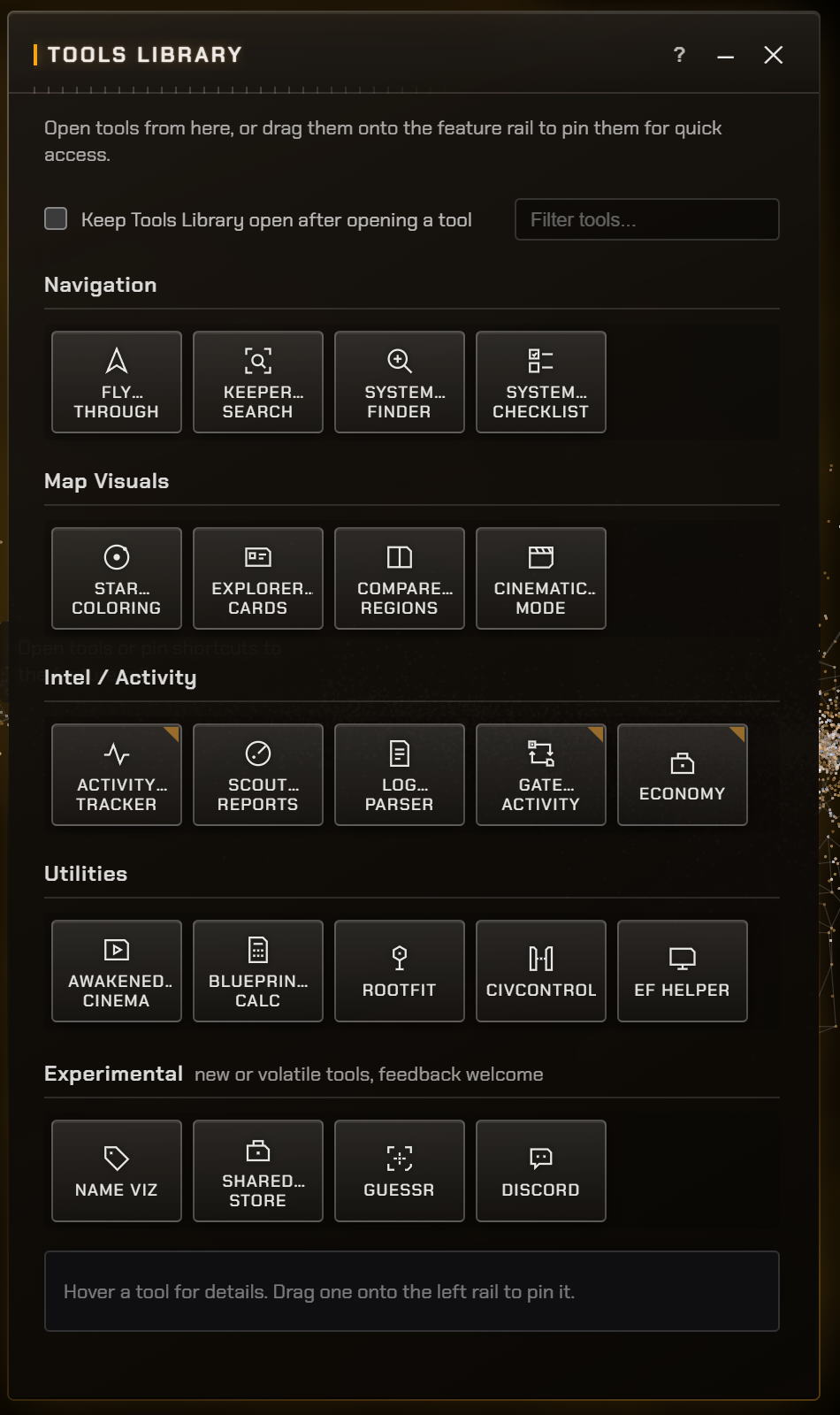
The Tools Library. The little clipped corners on Activity Tracker, Gate Activity and Economy mark the Intelligence family. Scout Reports and Log Parser next to them stay free.
When you deliberately open an Intelligence tool without access, you get a proper explanation of what the family is and what unlocking costs, rather than a nag. And I do mean deliberately: if you just search for a system while locked, the map quietly gets on with being a map. It will not spring an upsell on you as a side effect of normal navigation.
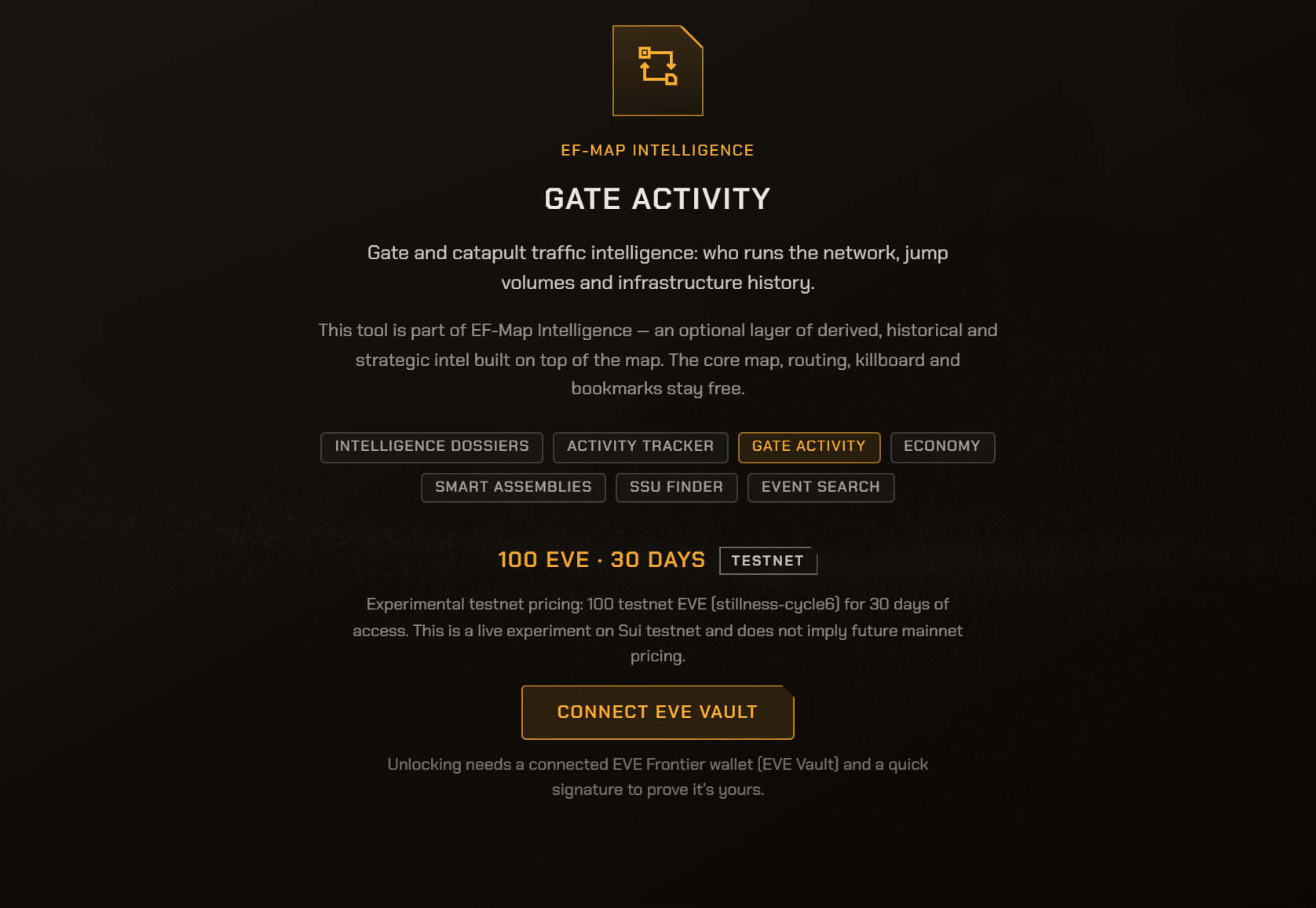
The locked state for Gate Activity: what the family includes, what it costs, and that it pays with the EVE already in your in-game Wallet. The wording here was tightened after early player feedback, with the test server disclaimer kept deliberately low key at the bottom.
Why there is a real boundary here
Here is the part that I think is genuinely interesting, and it is about architecture rather than money.
Most of EF-Map scales almost for free. The map data is static, the rendering happens on your machine, and the assets are served from a CDN. A thousand people opening the map is barely different from ten. The expensive, complicated part of EF-Map is the intelligence pipeline: an indexer running on a server, continuously ingesting and processing what happens in the game and on chain, feeding a database that keeps growing.
The way we have scaled intelligence features so far is snapshots. The indexer periodically produces a pre-computed summary, that summary is pushed out to the CDN, and everyone reads the same snapshot. It is fast, it scales beautifully, and hundreds of people can look at the same data at once without anyone's browser touching the database. Most of the current Intelligence tools still work exactly this way, and honestly it is a lovely architecture for what it does.
But snapshots have real limits. They can be a little behind real time. They only contain the views we decided to bake in when we generated them. And they are fundamentally the wrong shape for the most interesting questions, the ones where you want to combine filters, dig into history, or ask something we did not anticipate. SSU Finder taught us this early: letting people run real queries against the database gives far richer answers than any snapshot could, but unconstrained anonymous queries against a live database is how you end up with timeouts and a melted server. We ended up gating the full version of that search a long while ago for exactly this reason.
So one honest way to describe EF-Map Intelligence is this: it is the boundary inside which richer, live intelligence can safely exist. A known set of authenticated, entitled users making controlled queries is a completely different scaling problem from the entire anonymous internet hitting a database. With the boundary in place, we can start evolving these tools toward fresher data, deeper history and more flexible questions where that genuinely improves them, instead of every future idea having to be flattened into a snapshot first.
I want to be precise about what that means today, because I am not going to oversell it. Paying 100 EVE does not suddenly turn every panel into a live database view. Most Intelligence tools currently run on the same snapshot architecture they ran on last month. What the boundary buys is headroom, and a place where the richer stuff can be built without breaking the free map for everyone else. That is direction, not a promised feature list.
Why we built a whole commerce layer for this
This is the bit where a reasonable person asks why on earth a hobby map needs payment infrastructure. The answer is that EF-Map is not the only thing I build. There is also Civilization Control, RootFit, and whatever comes after them, and it was always likely that more than one of these would eventually need some way to accept payment, grant time-limited access, or sponsor transactions for users.
Building wallet payments, subscriptions, entitlements, treasury handling, receipts and recovery logic separately inside every app would be terrible engineering. You would end up with three slightly different, slightly wrong copies of the hardest code I own. So before monetising anything, we built the shared foundation once: a private infrastructure project called frontier-commerce. It handles EVE payments, time-limited entitlements, per-app merchant treasuries, accounting events for every payment, gas sponsorship, and the security separation between the keys that configure things and the keys that can move funds. EF-Map Intelligence is its first real consumer.
One design decision from that work matters to you directly as a user: EVE is the price, SUI is plumbing. When you unlock Intelligence, you pay 100 testnet EVE, and where our gas sponsor is healthy, EF-Map pays the tiny SUI network fee on your behalf. You should be able to think entirely in EVE. If the sponsor is ever unavailable, the app tells you plainly that your wallet will pay a small SUI fee instead, rather than silently doing something surprising. The payment itself never depends on the sponsor being up.
Why test this during testnet at all
The lazy path would be to wait. Leave the commerce layer in a drawer until mainnet, launch it when money is real, and hope. I think that is backwards, and the reason I say that is that first contact with real users breaks things, always, and you want that first contact to happen when the stakes are trivial.
If we waited for mainnet, we would be discovering at the worst possible moment that users find the wallet flow confusing, or that wallet authentication misbehaves in some edge case, or that the free versus Intelligence boundary makes no sense to anyone but me, or that our operational tooling is not up to supporting paying customers. We have already had a taste of how valuable early contact is: during my own first live purchase test, a transient failure in an upstream signing service pushed the app into a fallback that made an ordinary sign-in look like a scary asset-transfer approval. Finding and fixing that with 100 testnet EVE on the line is a mild Tuesday. Finding it at mainnet launch with real money would have been a disaster for trust.
The security thinking runs the same direction. Even though the current experiment is economically trivial, the commerce layer was built as if it will one day hold things that matter: configuration authority separated from money-moving authority, a sponsor wallet that only ever holds a small float so the worst case is losing pocket change, time-locked recovery paths, defensive validation on everything the sponsor is asked to sign, and an accounting trail for every payment. Mainnet is deliberately blocked in the code until this has all earned more review. Watching the wider ecosystem has reinforced that security, recoverability and operational discipline need to be designed before the assets matter, not bolted on afterwards.
And because EF-Map is a real product rather than a demo script, the test covers the whole journey a real customer would take: open the map, deliberately ask for Intelligence, connect EVE Vault, prove the wallet is yours with a signature, pay EVE, receive an entitlement recorded on chain, and have the tools unlock and stay unlocked across reloads because the server checks that entitlement, not because your browser remembered a flag. An isolated test saying "transaction succeeded" proves almost nothing next to that.
Why 100 EVE specifically
Because it needs to be real enough to test and cheap enough to be a non-decision. 100 EVE on the current testnet is intentionally negligible value, the sort of amount you can pick up through normal play. It is not an attempt to price what Intelligence is worth, and it is absolutely not a preview of mainnet pricing. Nothing about mainnet pricing has been decided, including whether the eventual model even looks like this one. What the 100 EVE does is force every part of the machine to actually run: a real wallet, a real signature, a real payment into a real treasury, a real entitlement with a real 30-day expiry, and real server-side checks on the paid data. Set the price to zero and half of that machine never gets exercised.
I will also be watching how it behaves as a product, through anonymous aggregate analytics: how often the locked screen is seen, how far people get through the unlock flow, which tools entitled users actually open. No wallet addresses, no identities, just counts of stages. That is the data that will eventually tell us whether this boundary makes sense to anyone besides me, and testnet is the right place to learn it, before real money makes every mistake expensive.
The honest bits
Some of the tools now inside Intelligence were freely accessible while they were being built, so this is a change, and I am not going to pretend otherwise. My view is that alpha access to features under construction and the long-term shape of the product are different things, and testnet, where unlocking costs pocket change, is the fairest possible moment to signal where the line is going to sit. If the boundary turns out to be drawn wrongly, I would much rather find that out now, argue about it on Discord, and move the line while moving it is cheap.
There are also things I am deliberately not announcing, because they are not built. Ideas like tribe-level access have been kicked around and remain just that, ideas. Mainnet plans, pricing and models are all genuinely undecided. What exists today is exactly what this post describes: a free core map, an optional Intelligence layer, a 100 testnet EVE unlock for 30 days, and the infrastructure underneath it getting its first proper workout.
If you try the unlock and something feels wrong, confusing, or simply not worth it, that is precisely the feedback this experiment exists to collect. Come and tell me on Discord. Cheers.
Related Posts
- Gate Activity: Who Owns the Jump Network in EVE Frontier - One of the Intelligence tools this post is about, and a good example of the derived-data layer
- Killboard Implementation: Tracking PvP Activity Across EVE Frontier - A server-backed community feature that stays free, and why
- Database Architecture: From Blockchain Events to Queryable Intelligence - The indexing pipeline that all of this intelligence is built on
- Improving EF-Map Visibility: Analytics, SEO, and AI Integration - The anonymous aggregate approach the new product analytics follows