Short version: the EVE token is EVE Frontier's blockchain currency, the out-of-game form of the money you earn in-game, and once it reaches Sui Mainnet it's designed to flow both ways between the game and the real world. If you know EVE Online, the one-line translation is that it's PLEX, except the door swings in both directions. That sentence is doing a lot of work, so let me unpack it properly. I've played Frontier with founder access since February 2025 and I build EF-Map and other tools on the game's chain, but I'm a player, not a finance person, and this is a mechanics explanation, not any kind of investment take.
The pieces
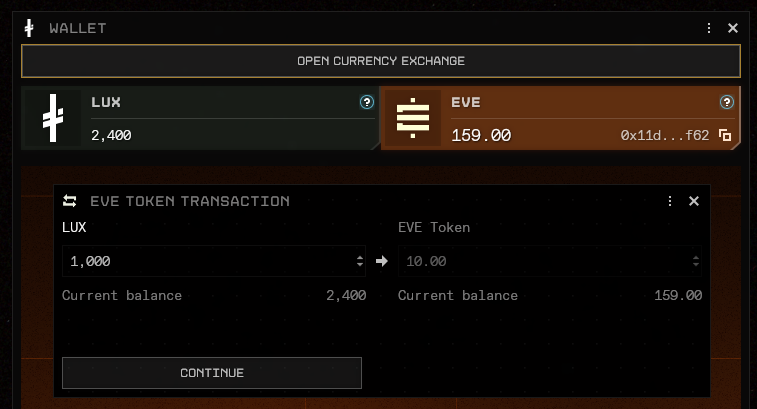
In-game you earn and spend Lux, the ordinary game currency. On the blockchain there's the EVE token, and the two are convertible, with 100 Lux to 1 EVE in the current Cycle 6 testnet economy. So Lux is the cash in your pocket and EVE is the same money in a form that exists outside the game client, on the Sui blockchain, where it can move through wallets, tools and services that aren't the game. From my reading of the whitepaper, the token's economics hang off fiat-referenced pricing of things you actually buy to play, the fuel-lens mechanism in particular, rather than off pure speculation, but I'd send anyone who wants the real detail to the official whitepaper itself, because that's the source and it will outlive anything I write here.
Right now, and this matters, the game runs on a test network. Nothing has real-world value today. Every cycle wipe deploys a fresh universe and a fresh token, and your testnet balance does not carry into the next cycle, the old ledger just stays on chain, abandoned in place. So anyone imagining they're accumulating something of value in the alpha has misread the situation. What's being tested is the loop, not the balance.
The loop being tested
This cycle the game forces everyone through the conversion at least once: you change Lux into EVE and spend it on lenses, which get you the fuel your ship burns. I read that as deliberate acclimatisation, getting players comfortable with the token plumbing while the stakes are zero. The current roadmap actually puts the token's deployment to Sui Mainnet before the full public launch, and once it's tradeable there, if the roadmap holds, the same plumbing becomes the legitimate bridge between in-game wealth and actual money.
That's the part with no EVE Online equivalent. PLEX let you turn real money into in-game wealth, but the flow was one-way by design, and making it run backwards was against the rules for twenty years. Frontier is built for the round trip. Play the game, earn Lux, convert to EVE, and out. Which has a consequence worth saying plainly: if your tribe pulls off a heist and empties another tribe's storages, converting that loot into real money is an intended part of the design, not an exploit. Sanctioned piracy with a cash-out window. Whether that thrills or horrifies you probably tells you a lot about whether this game is for you.
Will it be pay-to-earn? I doubt it in any meaningful sense. Mining rocks in a video game is always going to sit at the very bottom of any real dollars-per-hour scale, and the developers aren't pitching it as a job. The honest frame is that value can move, not that value is easily made. And is it pay-to-win? Not obviously more than EVE Online already is, where PLEX has bought in-game wealth for two decades. The difference here is symmetry, not a new sin.
The builder angle
There's a second, quieter thing the token changes, and as a tool builder it's the one I care about. EVE Online's standard developer licence doesn't let you charge players a real-money access fee for a tool. It allows in-game currency fees, cost-covering donations and advertising, but a paid product is off the table. Frontier takes a different position: the developers explicitly want builders to be able to create revenue streams, and the token gives us a native rail to charge on if we choose to. There's already been at least one testnet gambling site, which I'd normally roll my eyes at, except it proves the rails work. The part I find genuinely promising is what it does to the ecosystem. If a good tool can sustain its own server costs, or even pay its maker, the community gets better tools, maintained longer. That's the theory anyway, and I say that as someone who has run a free tool suite on this game for a year, so I have some skin in seeing how it plays out.
What it looks like from inside the game
Mundane, honestly. You won't see charts or tickers. You'll see Lux, a conversion step, and a wallet that signs you in with your normal game credentials like any single sign-on.
So that's the EVE token. In-game money with an exit, fiat-referenced on paper through the things you buy to play, worthless on testnet by design, and the load-bearing piece of the most interesting economic experiment any MMO studio is currently running. When it goes live with real value behind it, the player-built markets trading in Lux today are suddenly trading in something you can take out the door, and I don't think most people have clocked yet quite how novel that is.
Related Posts
- Why does EVE Frontier use the Sui blockchain? - the technology underneath the token
- What is EVE Frontier? A player's answer - the game all of this hangs off
- Open Market: an EVE Frontier player market that is actually open - where Lux actually gets spent today
- EVE Online vs EVE Frontier: what's actually different - the wider comparison, including the one-way PLEX door