I bought EVE Online on a disc in a shop in 2003 and played it on and off for two decades, ending up as a solo PvP hunter with a killboard I'm still quite proud of. I've now had EVE Frontier founder access since February 2025 and I build the EF-Map tools for it. So the comparison below is one player's, but it's a player who has put real hours into both, and I'll try to compare systems rather than vibes. Where the games are mid-change I'll say so, because Frontier is in alpha and moves every cycle.
The headline is that they started almost identical and are diverging fast, on purpose. When I joined Frontier in early 2025 it genuinely felt like the EVE Online I remembered from 2003, because it runs on the same Carbon engine and launched carrying a lot of inherited systems. Since then the developers have been swapping those out one at a time for Frontier-native replacements. This cycle alone the old fitting screen went, replaced by a modular one. The longer it runs, the less the comparison holds, which is itself the most important thing to know.
The quick table
| EVE Online | EVE Frontier | |
|---|---|---|
| World | One shard, persistent | One shard, persistent, but wipes in cycles during alpha |
| Map | Effectively 2D, stargate travel costs nothing | 3D and it matters, travel costs fuel, 24,000+ systems |
| Combat | Lock target, guns fire themselves, no line-of-sight occlusion | Manual aim on every weapon, occlusion blocks line of fire |
| Awareness | The overview window lists everything | Sensors, signatures, and looking out the window |
| Safety | Highsec, lowsec, nullsec, police response | None anywhere, ever |
| Skills | Real-time training queue | Memories earned by doing, banked into swappable crowns |
| Money | PLEX flows in only | Two-way bridge between in-game currency and the EVE token |
| Markets | Deep player markets hosted in NPC stations, hubs like Jita | Player-built markets on player structures, or nothing |
| Multiboxing | Common, whole playstyles built on it | Manual flight and aim make it much harder, deliberately I think |
Combat is the deepest difference
EVE Online's ordinary weapon combat has no line-of-sight rules. You lock a target, your guns fire themselves, and turret fire connects through your fleetmates, the station, and anything else in the way, because occlusion simply isn't modelled. Frontier has occlusion. If something is between you and the target, you can't shoot the target, and you can hide behind an asteroid and mean it. Quietly, that one mechanic breaks the four-hundred-man blob meta that EVE Online fleet warfare settled into, because a wall of ships can't all shoot through each other. As someone who spent years avoiding exactly that style of play, this is my favourite decision in the whole game.
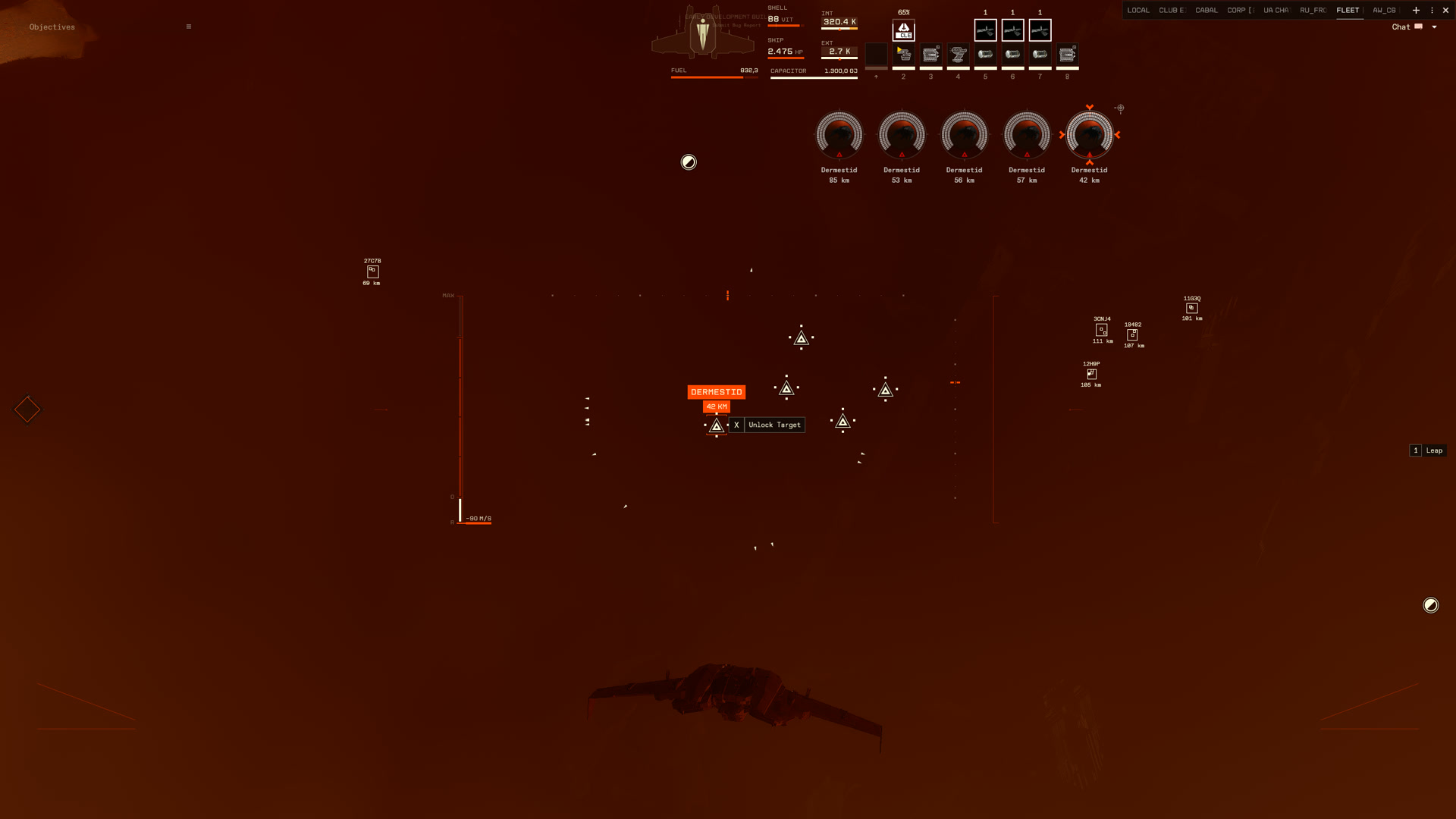
Cycle 6 pushed further. Every weapon right now is a skill shot, aimed manually with the mouse, no target lock required. It's closer to a survival shooter with spaceships than to EVE Online's spreadsheet duelling, and your ship spec matters less than whether you can actually land shots under pressure. They've said automatic point-defence style weapons may come later, so I'd treat the current state as one end of a pendulum. What I can tell you from doing both is that EVE Online PvP knowledge, damage types, tank scripts, reading an engagement, transfers beautifully, and the execution layer on top of it is entirely new.
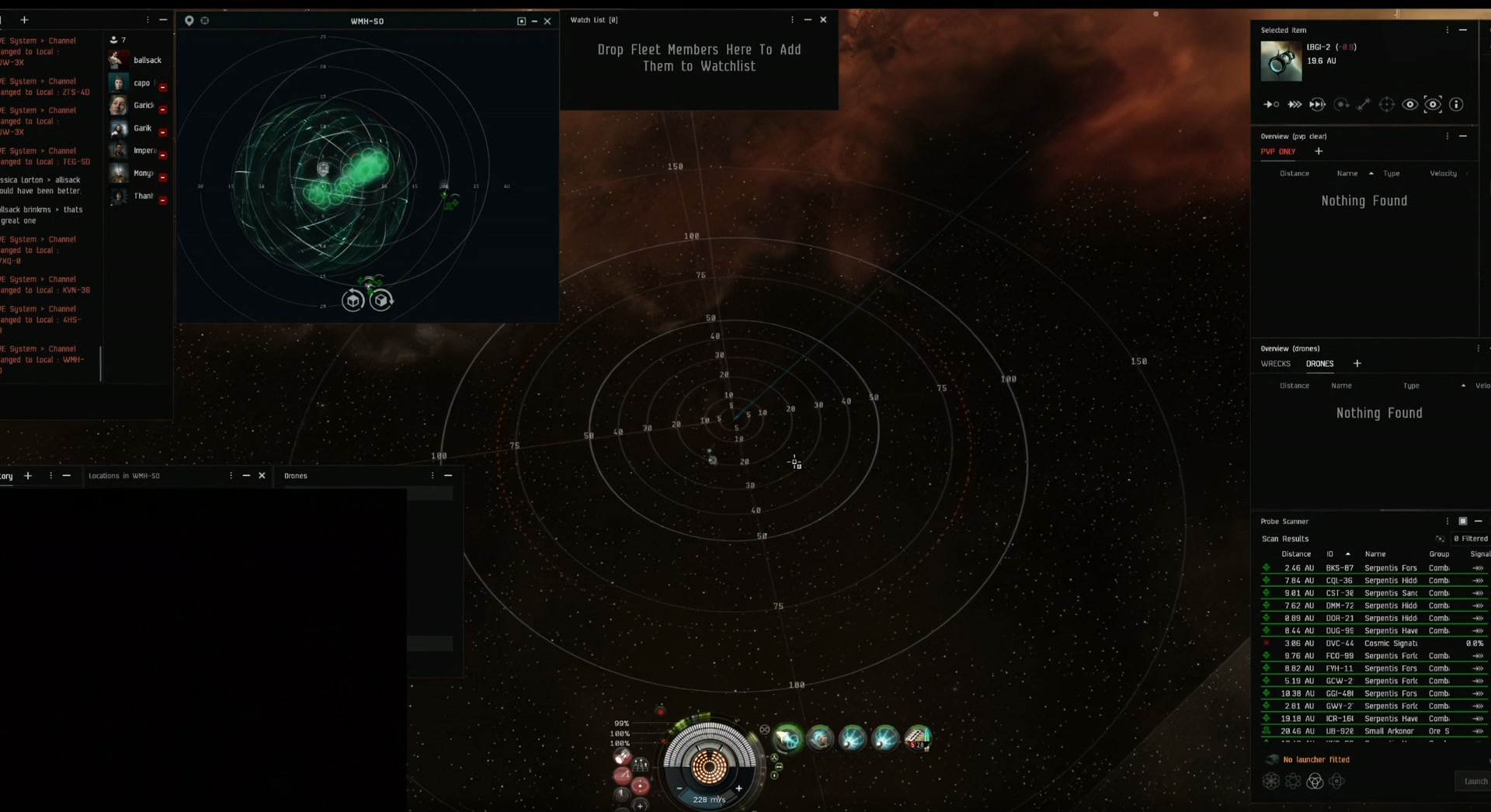
The other half of combat is information. EVE Online gives you the overview, a sortable window that lists everything in space with names and distances, and late-era EVE is mostly played through windows, zoomed out until your ship is a dot. Frontier has no overview. You get sensor returns, gravity for mass and EM for emissions, and contacts appear as unresolved signatures until you close in or point a directional scanner at them, which blooms your own signature while you do it. New modules this cycle let you suppress your EM signature and become an unresolved blip that might be an asteroid. The slow, sneaky hunting game I loved in EVE Online exists here in physical form, and it's better for it.
Travel, maps, and why I ended up building one
EVE Online's ordinary stargate travel consumes nothing. Gates connect systems, jumping through them is free, so distance is an abstraction and the flat 2D map has been fine for twenty years. Frontier makes travel cost fuel that you have to mine and refine, ships have jump ranges, and the universe is 24,000+ systems where most systems have no gate at all. Suddenly geometry is gameplay. Where things are, what's actually nearby in three dimensions, what a trip will cost, these are daily questions, and the in-game map has never answered them well. That gap is literally why EF-Map exists. This cycle there are no ship jump drives at all while they rework them, so travel is gates, player-built Smart Gates, and Catapults, which changes the geography again. Every cycle redraws what "far away" means, and I find that genuinely interesting in a way EVE Online's fixed geography stopped being. I did end up mapping the older universe as well, mind: EO-Map is the EVE Online version of this map, over at eo-map.com, and it will draw either the real 3D geometry or CCP's own published 2D layout.
Money and markets
Two economies, philosophically opposite. EVE Online has a deep, mature player market run through NPC station infrastructure, with trade concentrating in hubs like Jita, and it has worked that way for two decades. Frontier deliberately ships none of that infrastructure. In the current cycle there is no NPC market at all. If players want somewhere to trade, players have to build it, on their own structures, which are attackable, so even stocking a shop is a risk decision. The building blocks arrived this year and community tools are filling the space, including Open Market, which puts real order books on player storage units. Right now trading is thin and finding a market is half the challenge. I'd describe it as the frontier the game is named after.
The money boundary is the sharper difference. EVE Online's PLEX flows one way, you can turn real money into ISK but never legitimately back out. Frontier is built for the loop to close. The in-game currency converts to the EVE token on the blockchain, and once the token reaches Sui Mainnet that becomes a legitimate two-way bridge, which I've unpacked in a separate article because it deserves its own space. The short version is that stealing a tribe's assets and converting the loot into actual money is an intended possibility, and third-party tool builders get a native way to charge for their work, which EVE Online's developer licence doesn't allow.
Skills and starting late
EVE Online trains skills in real time whether you're logged in or not. A new player can eventually match an old character in one specialised role, but a 2003 character carries a breadth of accumulated skill points that a new character has no way to catch, and I've always thought that was the game's most quietly hostile design decision. Frontier throws it out. You accumulate memories by doing things, mining trains mining, fighting trains fighting, unascended memories are lost when you die, and through ascension you bank them into crowns, physical vessels for skills that you swap between, and right now can even hand to a tribemate, though I'd expect that detail to keep evolving. It's skills-by-doing with loss attached, it fits the survival frame, and your account creation date doesn't open a permanent training-time gap the way EVE Online's does. Between the two systems it isn't close for me.
Multiboxing, and who each game is for
I ran four EVE Online accounts, scouts, booster, main, because the game's design made that close to mandatory for my playstyle. Frontier's gameplay makes multiboxing close to impractical, manual flight, manual aim, no fleet warp crutches, and I read that as deliberate, engineering it out through the game rather than the rules. If so I think it's the right call, even though it kills a playstyle I used. You don't see multiboxers in DayZ or Rust, and that's the company Frontier's moment-to-moment game is starting to keep.
Atmosphere might actually be the fastest way to decide which game you'd like. I logged back into EVE Online recently to study its map and the game felt like a cartoon to me now, bright lights and windows, like walking into Tokyo at night. Frontier is the Wild West, dark, gritty, quiet, and you're in the weather rather than watching it through glass. Neither is wrong. They're just different games now.
So, the two direct questions. If you love EVE Online today, will you like Frontier? Maybe. It is not EVE Online 2, and the things late-era EVE players enjoy, the deep markets, the fleet doctrine metagame, the safety gradient, mostly don't exist here yet or ever. If you bounced off EVE Online, might Frontier still be for you? Absolutely, and honestly this is the more interesting audience. Almost everything people bounce off, the overview, the spreadsheets, the twenty-year head starts, is precisely what Frontier removed. Its five-day trial is free, and my full review covers what state the alpha is actually in before you commit an evening to it.
Related Posts
- What is EVE Frontier? A player's answer - the standalone explainer, no EVE Online knowledge assumed
- My EVE Frontier review after 18 months of founder access - the honest state of the alpha, including the population numbers
- Why does EVE Frontier use the Sui blockchain? - the technology behind the two-way economy
- Open Market: an EVE Frontier player market that is actually open - what player-built markets look like in practice